Executive summary
Revenue organizations have entered a new era. AI has moved from experimentation to everyday business. Sales teams now have more technology, more customer data, and more visibility into the sales process than ever before. Yet many organizations still struggle with the same core challenges: sales cycles are becoming longer, buyers are becoming more informed, managers have less time to coach, teams are overwhelmed by technology, and organizations still struggle to improve sales performance consistently. The challenge isn't adopting more technology — it's building an operating system that continuously improves how revenue teams prepare, execute, coach, and grow. This report examines the trends defining Revenue Performance in 2025 and why leading organizations are shifting from traditional sales enablement toward continuous performance improvement.
Key findings
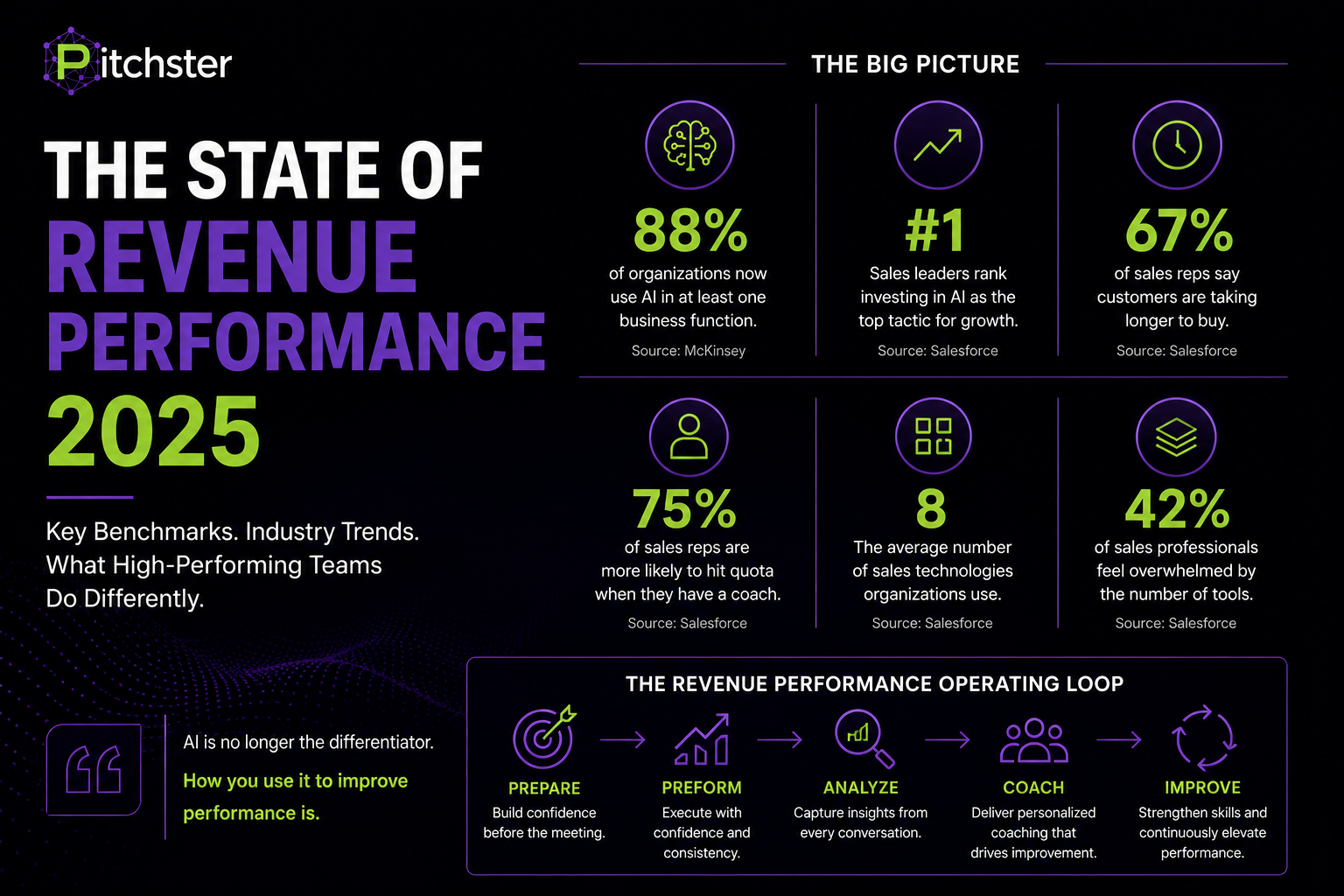
88% of organizations now use AI in at least one business function (McKinsey, The State of AI). 67% of sales reps report customers are taking longer to make purchasing decisions than a year ago (Salesforce State of Sales). 42% of sales professionals feel overwhelmed by the number of sales technologies they use daily (Salesforce). The average sales organization now relies on approximately 8 different technologies throughout the sales process (Salesforce). 75% of sales professionals say they are more likely to achieve quota when they receive coaching or mentorship (Salesforce). Only 1% of organizations believe they have fully achieved AI maturity (McKinsey).
Trend 1 — AI adoption is no longer the competitive advantage
Just a few years ago, organizations asked whether AI belonged inside sales. That question has largely been answered — the majority of organizations now use AI somewhere within the business. The new question is different: Where does AI create measurable performance improvement? Leading revenue organizations are shifting away from isolated AI tools toward AI embedded directly into daily workflows. Rather than using AI simply to automate tasks, they use AI to prepare salespeople, improve conversations, coach managers, and measure skill development. The competitive advantage is no longer having AI. It is operationalizing AI.
Trend 2 — More technology has not solved the performance problem
Sales technology has exploded over the past decade: CRM, conversation intelligence, sales engagement, revenue intelligence, forecasting, learning management, enablement platforms. Despite this growth, many organizations continue to struggle with consistency. Sales teams now use approximately 8 different technologies, and 42% of sales professionals report feeling overwhelmed by the number of systems they must navigate. Technology has improved visibility — it has not automatically improved execution. The organizations creating the greatest results are simplifying workflows instead of adding complexity.
Trend 3 — Customer conversations have become more important than ever
Modern buyers arrive more informed. Buying committees are larger. Sales cycles continue to expand. Every conversation now carries greater influence than ever before. Nearly seven out of ten sales reps believe customers take longer to make purchasing decisions than they did previously. That means every discovery call, every executive meeting, every objection, every presentation matters more. Organizations cannot afford for customer meetings to become practice sessions. Preparation has become a competitive advantage.
Trend 4 — Coaching is becoming the greatest performance multiplier
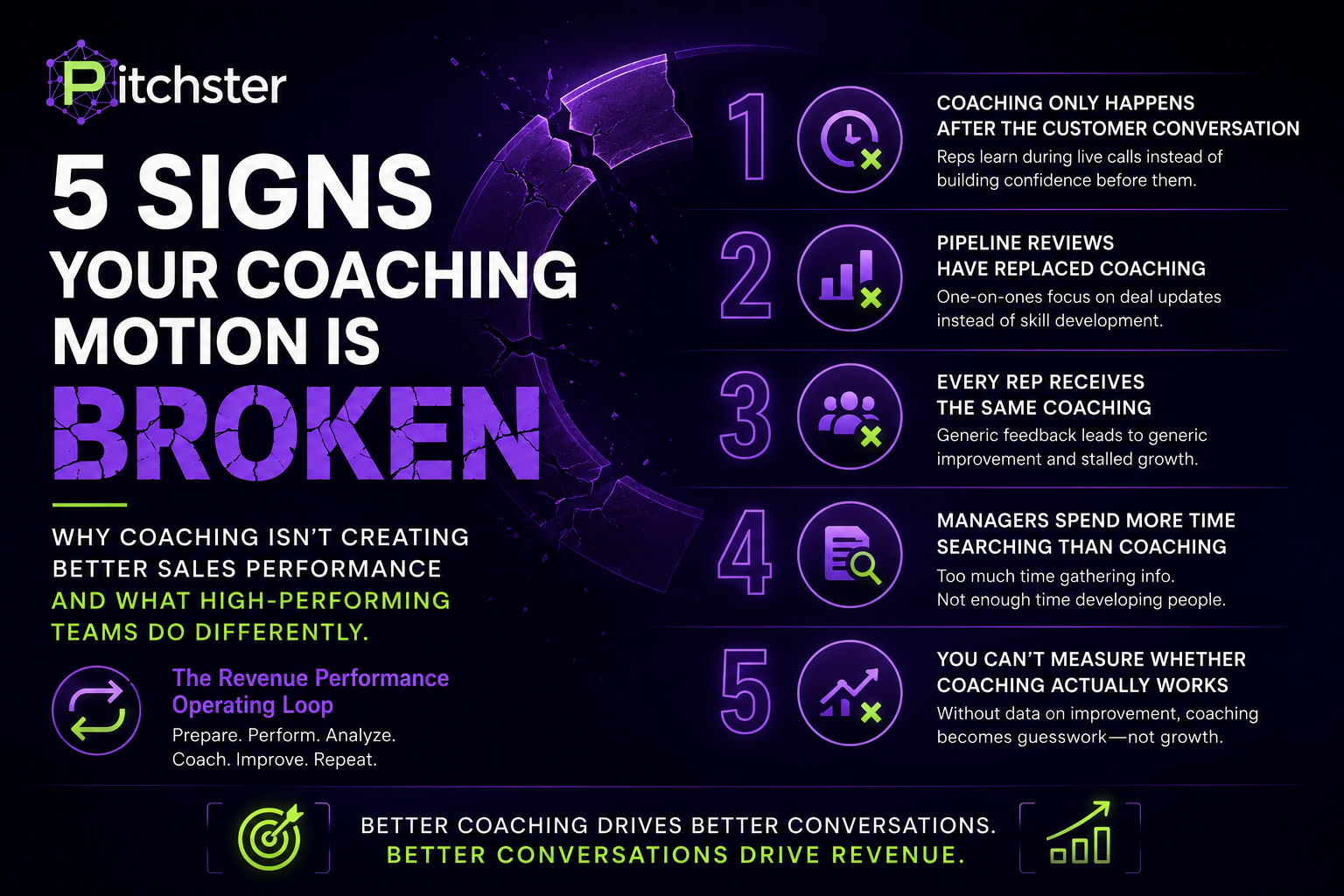
Technology continues improving productivity. Coaching continues improving people. Salesforce research found 75% of sales professionals believe coaching directly improves their likelihood of reaching quota. Yet managers face the same challenge — pipeline reviews, forecast meetings, internal reporting, hiring, customer escalations, and administrative work all compete for coaching time. As organizations scale, coaching must become more objective, more measurable, and easier to deliver consistently. The future of coaching is not replacing managers with AI. It is equipping managers with better performance intelligence.
Trend 5 — Continuous readiness is replacing one-time training
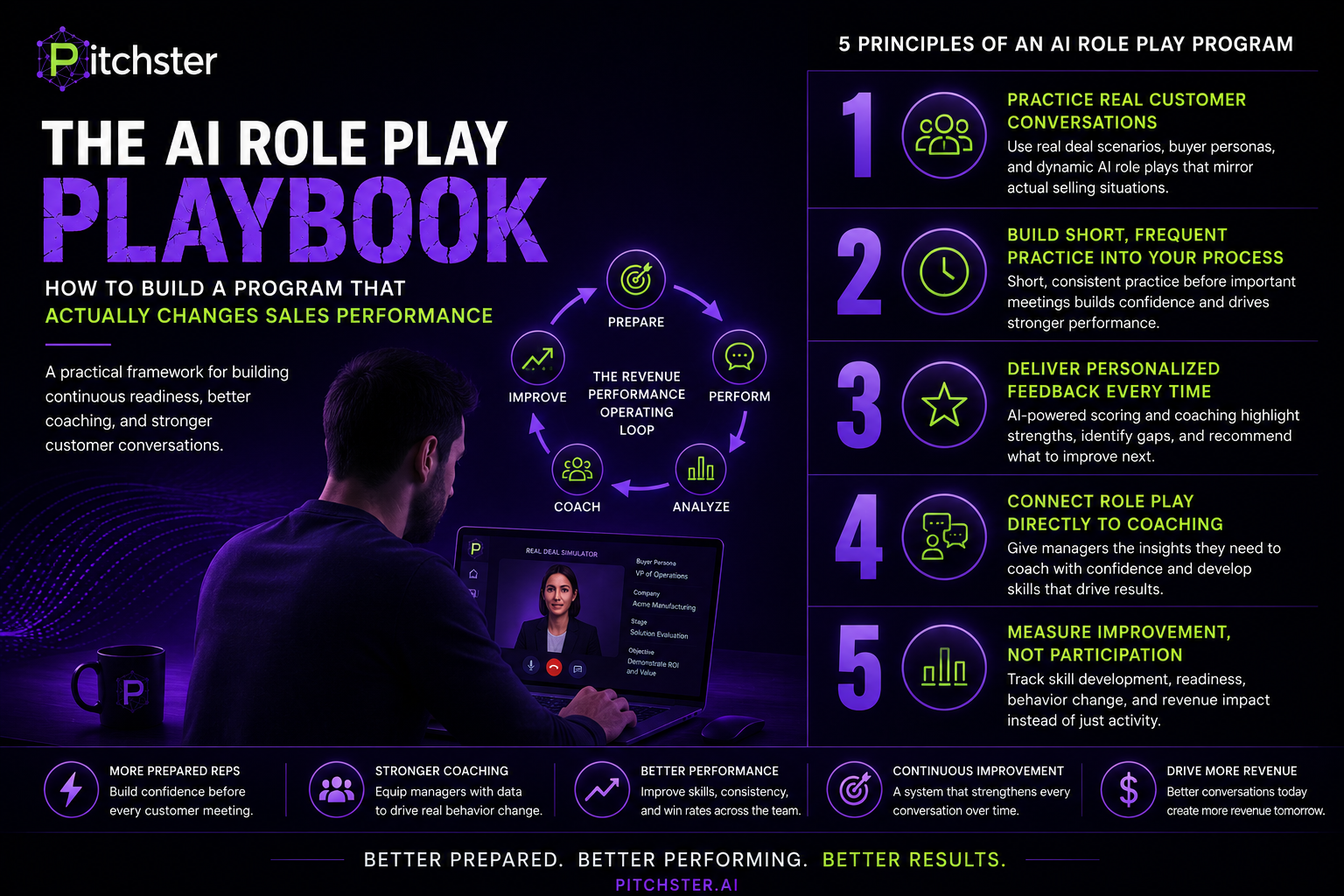
Traditional enablement follows a familiar pattern: onboard, train, role play, sell, repeat. High-performing organizations now think differently. Learning doesn't stop after onboarding. Preparation doesn't happen only before QBRs. Role play isn't reserved for new hires. Readiness becomes continuous — salespeople practice before important meetings, managers coach every week, performance is measured after every conversation, and improvement compounds over time. Organizations no longer ask 'Did our team complete training?' They ask 'Is our team improving every week?'
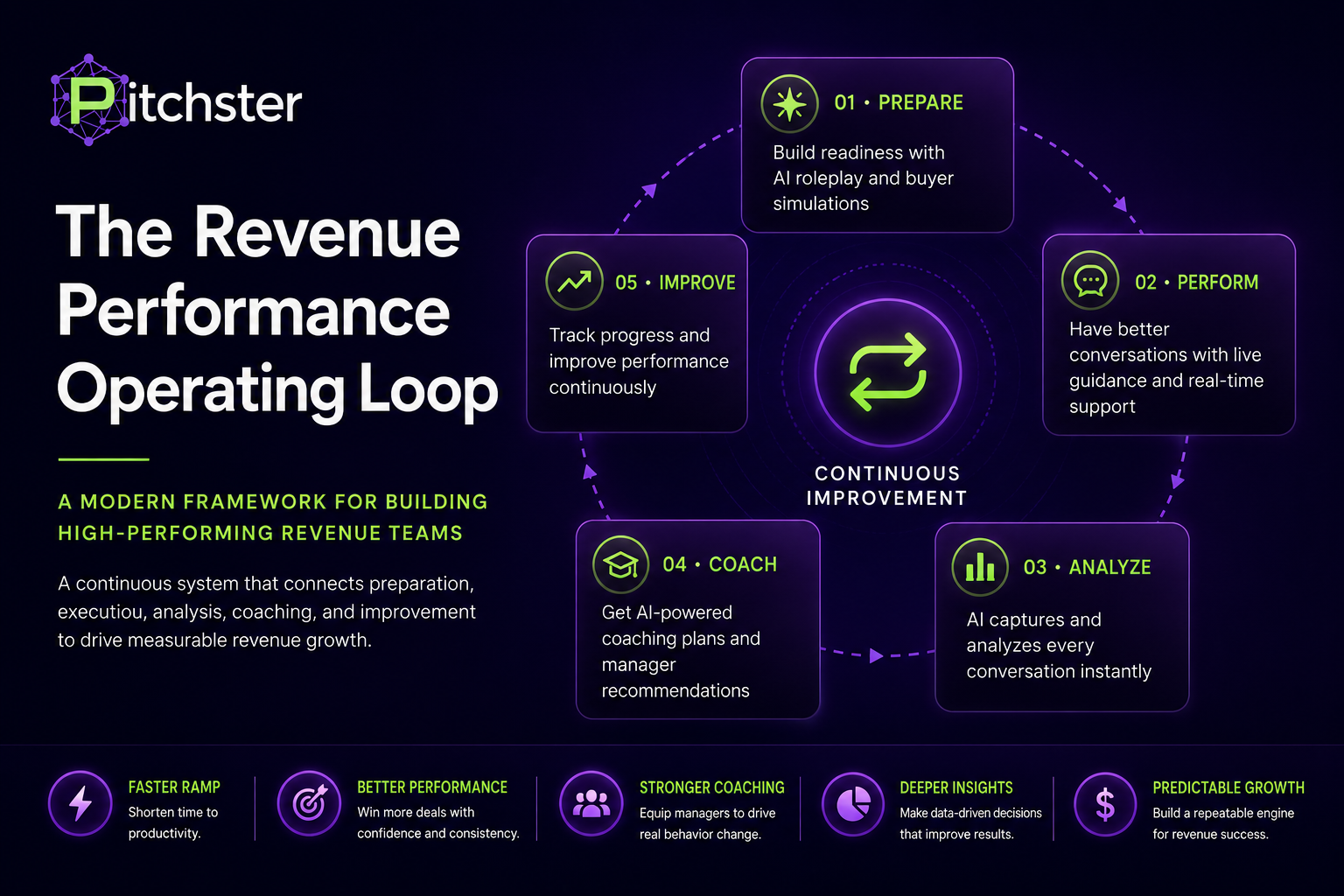
The Revenue Performance Operating Loop
High-performing organizations operate through a continuous cycle: Prepare (build confidence before customer conversations through structured practice, AI role play, and opportunity-specific rehearsal) → Perform (execute customer conversations with greater confidence, consistency, and effectiveness) → Analyze (capture every conversation to identify strengths, coaching opportunities, and measurable performance trends) → Coach (provide personalized coaching focused on behaviors rather than simply reviewing deal outcomes) → Improve (strengthen skills, build confidence, and continuously improve future customer conversations) → Repeat. Every customer conversation becomes preparation for the next.
The five characteristics of high-performing revenue organizations
1) They prepare before revenue is on the line — practice becomes part of the sales process, a habit, not an event. 2) They coach behaviors instead of deals — managers improve discovery, objection handling, executive communication, business value, and confidence, not simply forecast accuracy. 3) They measure readiness — beyond pipeline, activity, and CRM updates, they measure performance. 4) They use AI to develop people — AI assists coaching, improves preparation, identifies trends, and creates consistency. 5) They build continuous improvement — small improvements repeated daily become competitive advantages.
The Revenue Performance Index
Where does your organization currently operate? Level 1: Sales Training. Level 2: Sales Enablement. Level 3: Conversation Intelligence. Level 4: Revenue Performance. Level 5: AI-Driven Revenue Organization. Organizations move up this maturity curve by connecting preparation, execution, coaching, and improvement into one operating system instead of relying on disconnected initiatives.
Looking ahead
Over the next several years, AI will become standard across nearly every revenue organization. The competitive advantage will no longer come from having AI. It will come from preparing people better, coaching them more consistently, measuring performance more effectively, and continuously improving every customer conversation. Organizations that build continuous Revenue Performance systems today will create lasting advantages that extend far beyond technology.