Executive summary
Revenue teams have never had more technology available to improve performance. Organizations invest heavily in CRM, sales engagement, conversation intelligence, learning management, enablement content, forecasting, and AI assistants. Yet many still experience the same challenges: lengthy ramp times, complex buying cycles, inconsistent coaching quality, training disconnected from execution, and insights that rarely influence future preparation. The problem is not a lack of technology — it's that most organizations operate with disconnected systems rather than a continuous performance model. Training happens during onboarding. Preparation happens individually. Coaching happens after meetings. Call reviews happen after deals progress — or after they are lost. Performance data lives in dashboards but rarely changes future behavior. The highest-performing revenue organizations create a continuous cycle where preparation improves execution, execution creates insight, insight improves coaching, and coaching strengthens future preparation. We call it The Revenue Performance Operating Loop.
The current state of revenue performance
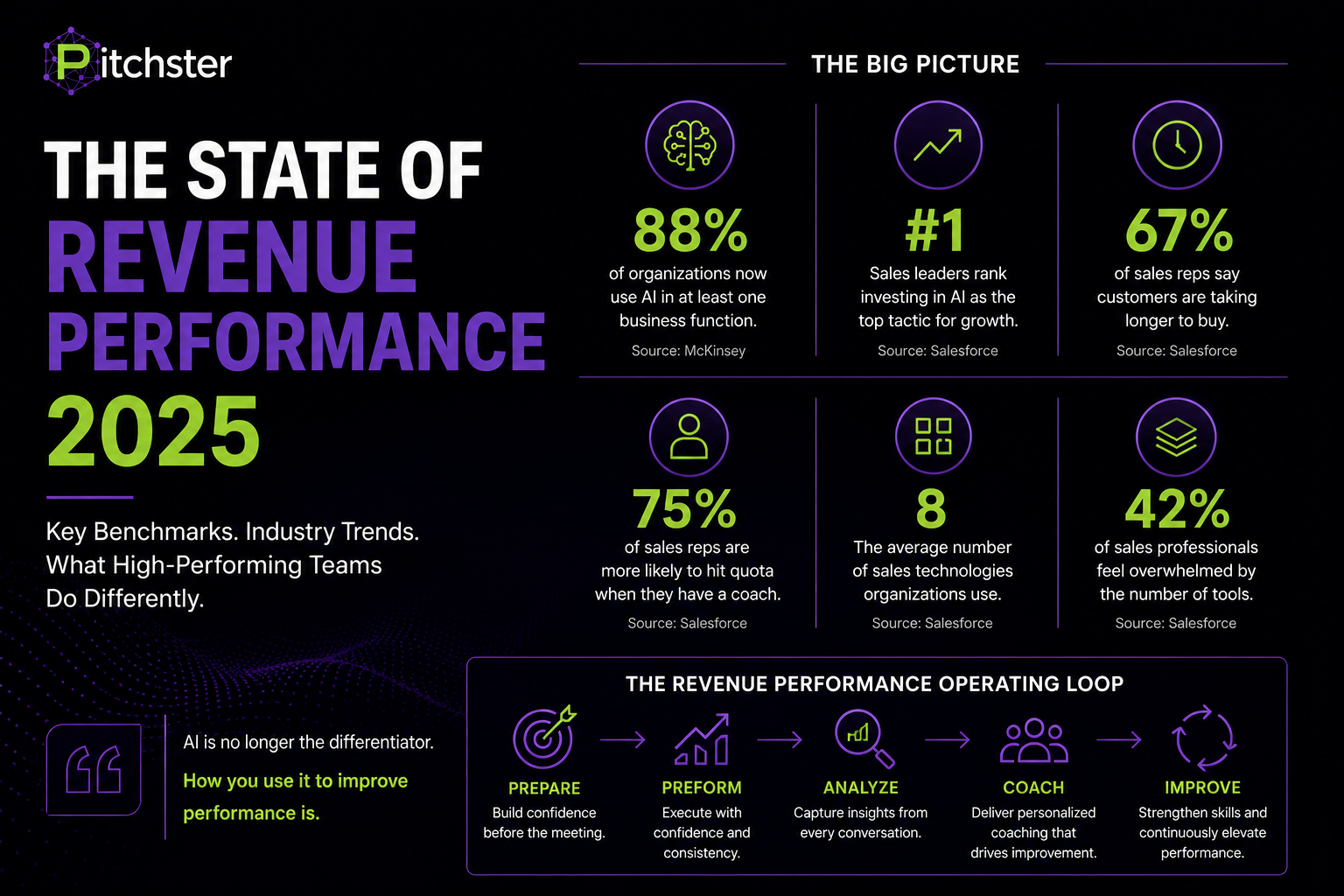
Selling has changed dramatically. Modern buyers conduct significant research before speaking with sales. Purchasing decisions involve larger buying committees, longer evaluation periods, and higher expectations for every customer interaction. Salesforce reports 67% of sales reps say customers take longer to make purchasing decisions than a year ago; 42% of sales professionals feel overwhelmed by the number of tools they use; and the average sales organization now relies on approximately 8 different technologies throughout the sales process. Technology has improved visibility. It has not necessarily improved execution. Organizations now understand more about what happened — the bigger challenge is improving what happens next. Improving sales performance requires more than adding another tool; it requires an operating system that continuously improves every customer conversation.
Why traditional sales enablement falls short
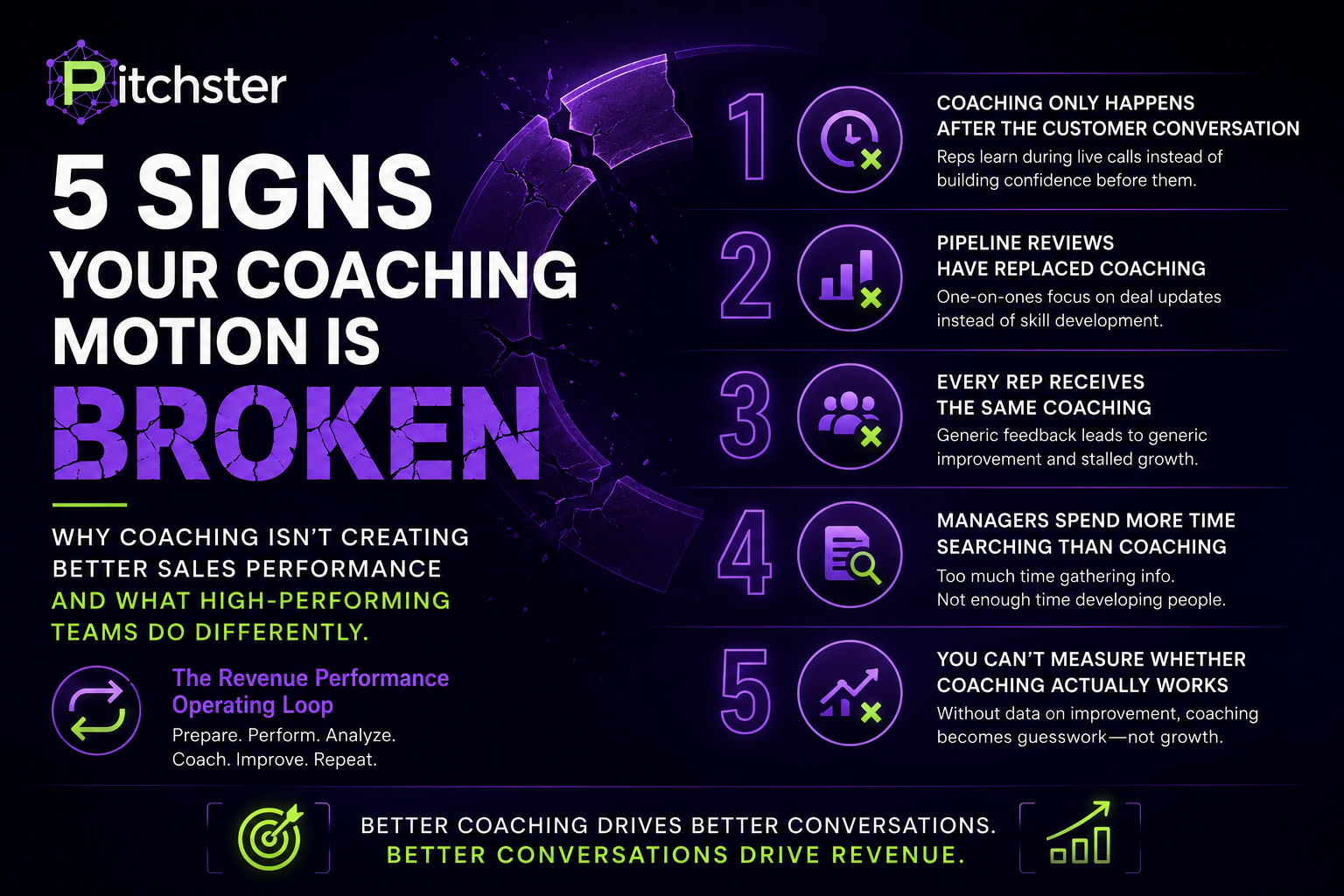
Traditional enablement follows a familiar pattern: new reps complete onboarding, managers conduct occasional coaching, calls are recorded and reviewed, quarterly training reinforces messaging, and leadership monitors dashboards. Each activity provides value independently, but they rarely operate as a connected system. Training ends after onboarding. Practice becomes optional rather than continuous. Coaching focuses on deal reviews instead of skill development. Conversation analysis explains past performance without improving future performance. Managers spend more time inspecting pipeline than improving selling behaviors. The result is predictable: improvements happen slowly, knowledge fades, coaching varies from manager to manager, and new hires require extended ramp periods. Organizations don't need more isolated activities — they need an operating model that connects every stage of sales development.
Introducing the Revenue Performance Operating Loop
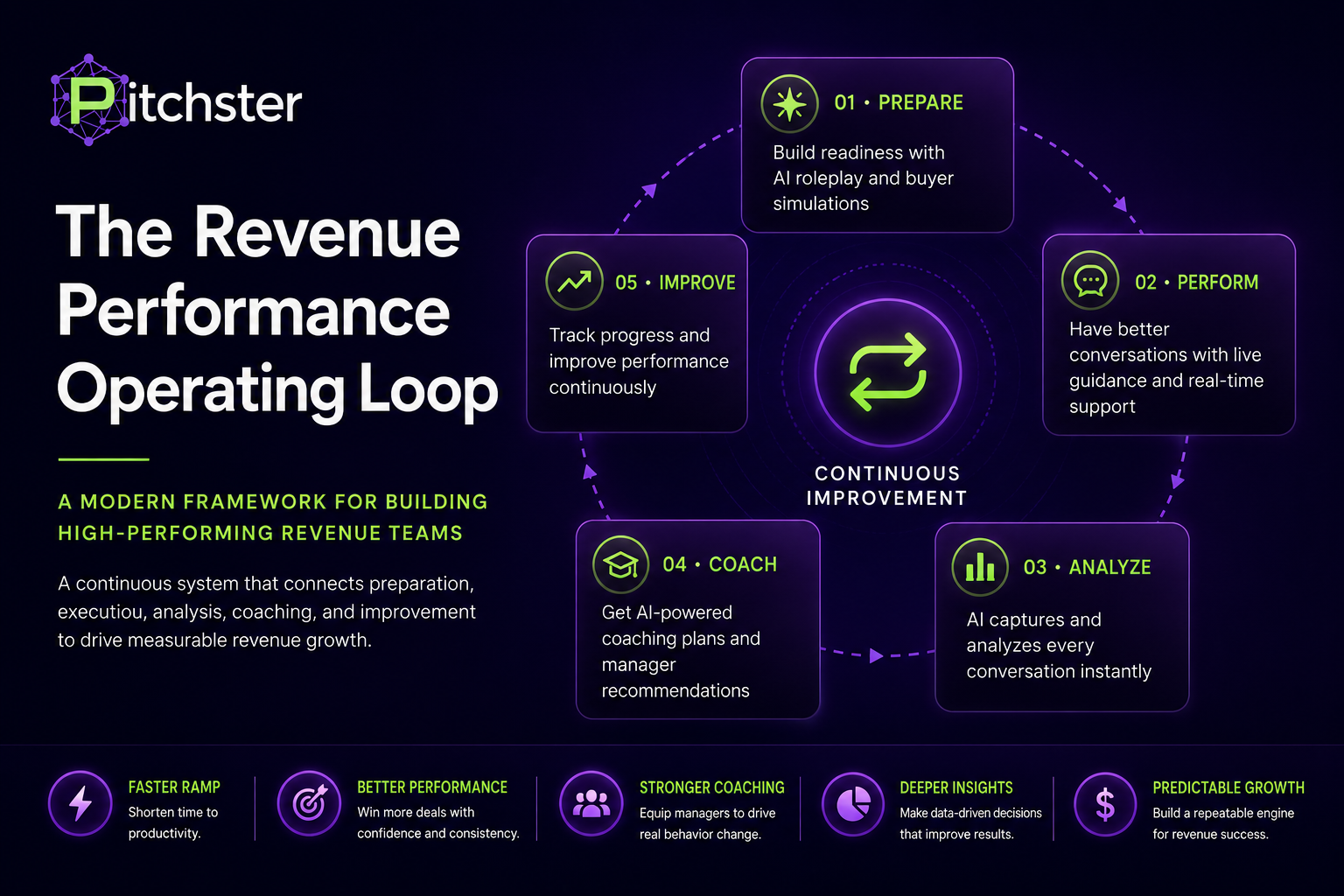
The Revenue Performance Operating Loop is a continuous framework designed to improve revenue performance before, during, and after every customer interaction. Rather than viewing sales enablement as a collection of separate initiatives, the framework connects every activity into one continuous cycle: Prepare → Perform → Analyze → Coach → Improve → Repeat. Each stage strengthens the next. Preparation improves execution. Execution creates measurable performance data. Performance data enables better coaching. Better coaching improves future preparation. The cycle repeats after every customer conversation. Over time, organizations create a culture of continuous improvement rather than periodic training.
Stage 1 — Prepare: preparation creates confidence
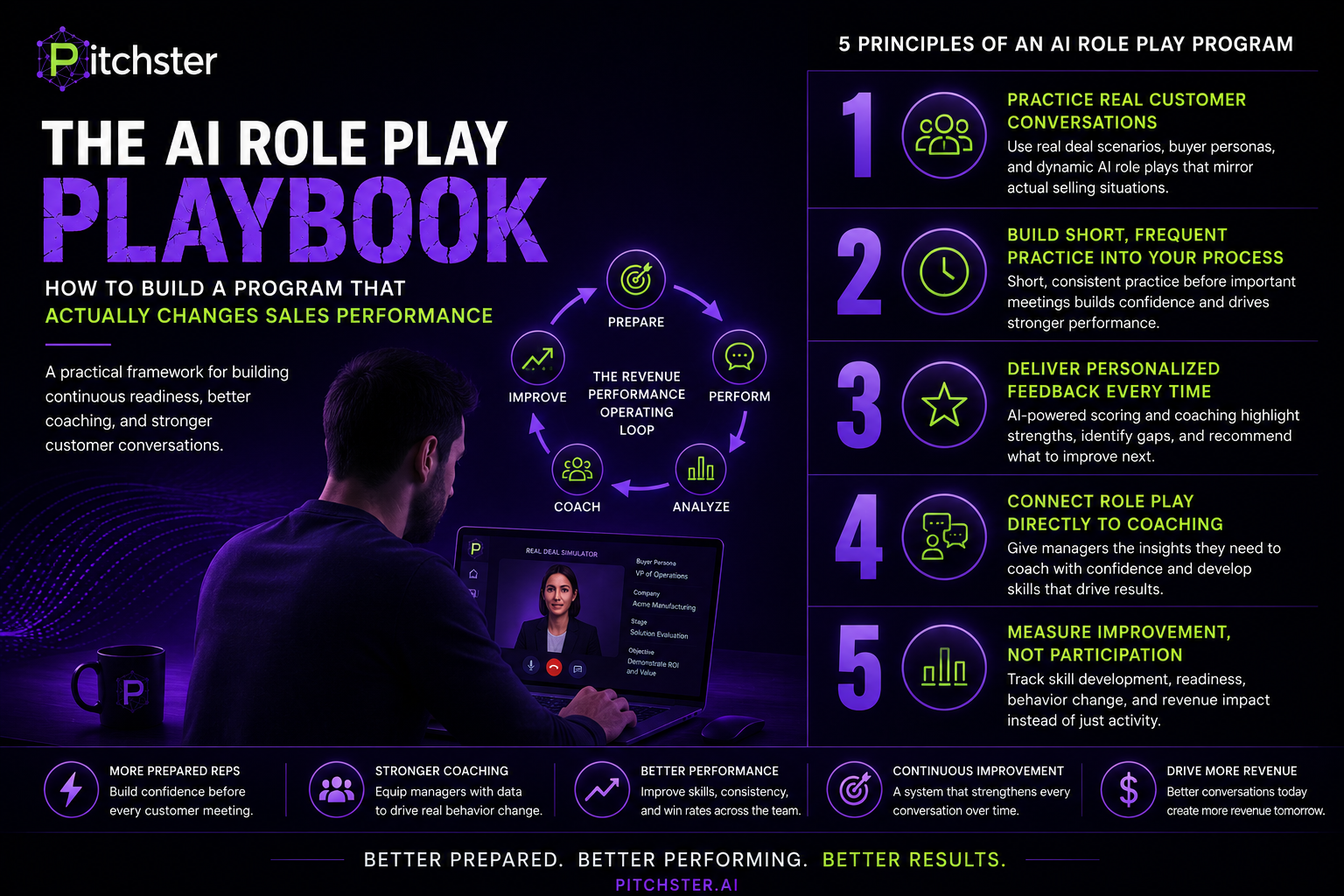
Every successful customer conversation begins before the meeting starts. Unfortunately, preparation is often limited to reviewing CRM notes, reading company websites, or scanning LinkedIn profiles. Information creates awareness — practice creates readiness. Elite performers across nearly every profession understand this: professional athletes train before competition, pilots complete simulation exercises before flying, military units rehearse missions repeatedly before execution. Sales professionals deserve the same level of preparation — practicing discovery, rehearsing objection handling, testing messaging, building confidence for high-value opportunities, and receiving coaching before customer interactions. Preparation shifts learning from live customer conversations to controlled practice environments, and typically produces faster onboarding, increased confidence, better meeting quality, more consistent messaging, and reduced first-call anxiety.
Stage 2 — Perform: execution is where revenue is won
Preparation has only one purpose: improving performance. Every customer conversation is an opportunity to create trust, uncover business problems, differentiate value, and move opportunities forward. As buying cycles become more competitive, execution becomes the defining factor between average organizations and exceptional ones. High-performing organizations understand consistency matters more than isolated excellence. Rather than depending on a handful of elite sellers, they build systems that help every rep execute proven selling behaviors — asking stronger discovery questions, listening more effectively, handling objections with confidence, communicating value clearly, and guiding conversations toward meaningful next steps. Execution becomes repeatable rather than unpredictable.
Stage 3 — Analyze: every conversation contains valuable data
Every customer interaction generates information. The challenge is transforming that information into measurable improvement. Traditional call reviews often answer 'Did we win? Did we lose? What happened?' High-performing organizations ask different questions: Which behaviors consistently create successful outcomes? Which discovery techniques produce better conversations? Where do reps struggle most frequently? Which coaching initiatives improve future performance? What skills require additional reinforcement? Analysis transforms conversations into performance intelligence. Coaching decisions become evidence-based rather than opinion-based. Performance trends become visible, improvement opportunities become measurable, and leadership gains visibility into organizational readiness rather than simply historical results.
Stage 4 — Coach: coaching creates continuous improvement
Technology cannot replace coaching. It can make coaching significantly better. Salesforce research shows 75% of sales professionals are more likely to achieve quota when they receive coaching or mentorship. Yet coaching remains one of the least scalable activities inside many organizations — managers balance hiring, forecasting, pipeline reviews, executive meetings, escalations, and administrative work, and coaching often becomes reactive. High-performing organizations coach the behaviors that influence future outcomes: discovery effectiveness, active listening, objection management, business value communication, closing confidence, and executive presence. Effective coaching is continuous, objective, behavior-focused, and measurable. The objective is not simply closing today's opportunity — it's improving every future opportunity.
Stage 5 — Improve: small improvements compound
Improvement is not an event — it is the result of repeating the operating loop consistently. Every practice session improves confidence. Every conversation creates insight. Every insight strengthens coaching. Every coaching session improves preparation. Organizations that continuously improve gain advantages competitors struggle to replicate: better sales consistency, faster onboarding, stronger coaching cultures, higher confidence, greater forecast accuracy, and improved customer experiences. The competitive advantage is rarely one dramatic breakthrough — it is hundreds of small improvements repeated every day.
Business outcomes
Sales representatives experience faster readiness, greater confidence, better conversations, increased consistency, and continuous skill development. Frontline managers gain higher-quality coaching, objective performance visibility, better prioritization of coaching time, and stronger team consistency. Revenue leadership sees shorter ramp times, better forecast confidence, greater coaching consistency, improved sales execution, and stronger revenue predictability. The operating loop creates organizational learning that compounds over time — every conversation improves the next.
Revenue Performance is the next evolution of sales enablement
Sales enablement transformed how organizations approached onboarding, training, and content management. Conversation intelligence transformed visibility into customer meetings. AI is transforming productivity. The next evolution is connecting these capabilities into a continuous performance system. Revenue Performance is not another technology category — it is an operating philosophy. Organizations that embrace continuous preparation, execution, analysis, coaching, and improvement will outperform organizations that rely on isolated training events. Future revenue leaders will not ask 'Did our team complete training?' They will ask 'Is our team continuously improving?' That distinction changes everything.